Our Location
1130 Upper Hembree Rd , Roswell, GA 30076
Read this first: pressure matters, and so does what a chamber is cleared for.
Nearly all the clinical research on hyperbaric oxygen was done in hard-shell chambers at 2 to 3 ATA . Those are the chambers behind the FDA-cleared indications: decompression sickness, carbon monoxide poisoning, gas gangrene, crush injury, certain non-healing wounds, delayed radiation injury, severe anaemia, compromised grafts and sudden hearing loss.
Soft-shell portable chambers run near 1.3 ATA and are cleared in the United States for one thing: acute mountain sickness. Research conducted at 2.4 ATA does not transfer to 1.3 ATA, and this article should not be read as saying it does.
HBOT is not cleared or clinically proven for cancer, Alzheimer's, autism, Lyme disease, multiple sclerosis, Parkinson's, diabetes, sports performance or anti-aging. See what HBOT is and is not for and our hyperbaric oxygen therapy page .
A comprehensive guide to at-home and clinical soft-shell HBOT, science, safety, and selection
The Science: How Portable HBOT Works
Henry’s Law and Dissolved Oxygen
The mechanism rests on Henry’s Law: the amount of gas dissolved in a liquid is directly proportional to the partial pressure of that gas above the liquid. At 1.5 ATA breathing 100% oxygen, plasma oxygen content rises by approximately 10-fold compared to normal atmospheric conditions, allowing oxygen to reach tissues that may be hypoxic due to poor circulation, injury, or inflammation.
Cellular and Physiological Effects
The downstream effects of elevated tissue oxygen include:
- Angiogenesis , stimulation of new blood vessel growth in damaged areas
- Fibroblast activation , accelerated collagen synthesis for wound repair
- Immune modulation , reduction of systemic and local inflammation
- Neuroplasticity support , improved cerebral oxygenation and metabolic activity
- Stem cell mobilization , increases circulating stem cells by up to 800%
- Antimicrobial effects , high oxygen tension is toxic to anaerobic bacteria
Anatomy of a Portable Hyperbaric Chamber
Construction and Materials
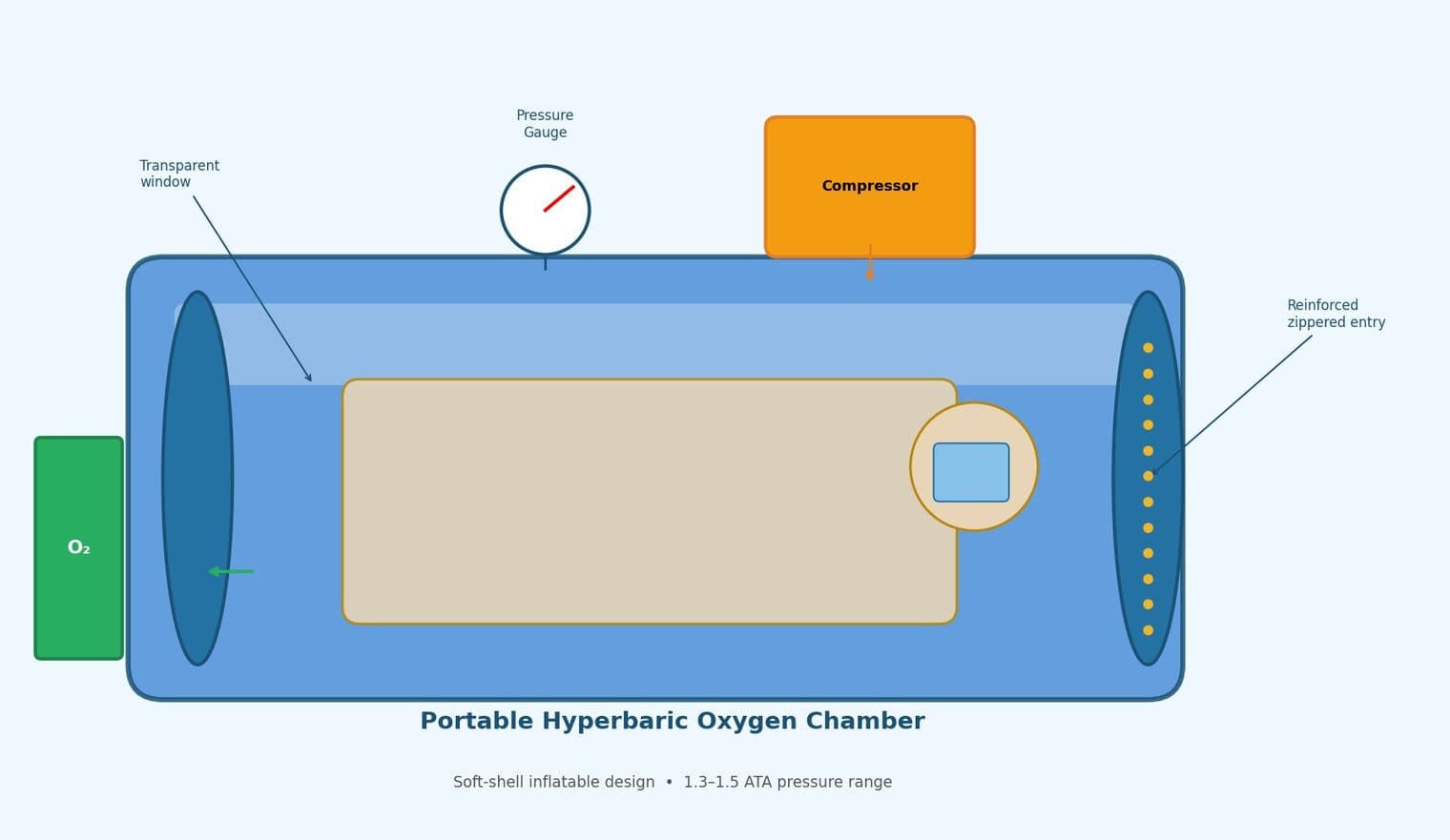
Modern portable chambers are constructed from multi-layer urethane-coated nylon or reinforced PVC with welded seams capable of sustaining pressures up to 1.5 ATA. A large-diameter airtight zipper, engineered for aerospace and diving applications, forms the entry and exit point. Most models include at least one transparent acrylic or polyurethane window to reduce claustrophobia and allow communication.
Oxygen Delivery System
An external electric air compressor inflates the chamber to target pressure. Oxygen is introduced via a separate line connected to either an oxygen concentrator (producing 90 to 96% pure O₂) or a pressurized medical oxygen cylinder. Inside the chamber, the user breathes through a soft non-rebreather mask or a hood delivery system. Flow rates of 8 to 10 liters per minute are typical at 1.3 to 1.5 ATA.
Pressure and Safety Controls
Every compliant chamber incorporates a calibrated pressure gauge and an adjustable pressure relief valve, which automatically vents excess pressure and prevents over-pressurization. A manual deflation valve allows the user or an attendant to quickly reduce pressure. Modern units also feature an internal pressure release that the occupant can activate from inside.
A Typical Session: Step-by-Step Protocol
Conditions Treated and Clinical Benefits
Wound Healing
HBOT is most firmly established in wound care. Chronic non-healing wounds, diabetic foot ulcers, radiation-induced tissue injury, and refractory osteomyelitis, respond well to serial sessions. Studies consistently demonstrate accelerated closure rates and reduced amputation risk in diabetic ulcer patients treated with HBOT alongside standard wound care protocols.
Sports and Athletic Recovery
Elite athletes increasingly use portable chambers for post-competition recovery. The anti-inflammatory effects and accelerated lactic acid clearance reduce delayed-onset muscle soreness (DOMS). Multiple professional sports teams integrate HBOT into recovery programs, citing reduced time to return-to-play following muscle strains and ligament injuries.
Neurological and Cognitive Applications
Emerging evidence supports HBOT for traumatic brain injury (TBI), post-COVID neurological symptoms (long COVID), post-stroke recovery, and neurodevelopmental conditions including autism spectrum disorder. Improved cerebral oxygen delivery and reduction of neuroinflammation are proposed as the primary mechanisms.
Immune System Modulation
By reducing systemic oxidative stress and modulating inflammatory cytokines, HBOT has been studied in relation to immune signalling. None of chronic infection, autoimmune flares or post-surgical inflammation is a cleared indication, and we do not offer HBOT on that basis.
Anti-Aging and Longevity
Recent Israeli research demonstrated that repeated HBOT sessions induced telomere elongation, a reversal of a key cellular aging marker, and reduced senescent cell burden in healthy older adults. While these findings are preliminary, they have ignited significant interest in HBOT within the longevity medicine community.
Conclusion
Portable hyperbaric oxygen therapy represents a meaningful evolution in accessible medicine. While lower pressures than rigid hard-shell chambers limit certain acute indications, the 1.3 to 1.5 ATA range achieves substantial increases in tissue oxygen delivery sufficient for wound support, athletic recovery, neurological benefit, and immune modulation.
As research continues to accumulate, particularly in long COVID, TBI rehabilitation, and aging, portable HBOT is poised to become an increasingly mainstream therapeutic tool. Prospective users are encouraged to consult a qualified healthcare provider, obtain a thorough medical evaluation, and purchase only FDA-cleared or CE-marked devices from reputable manufacturers.
Ready to heal naturally?
Start your personalized naturopathic, functional & holistic care plan in Roswell, GA, proudly serving Alpharetta, Atlanta & the greater Fulton County area.
Search
Categories
- Adrenal Health 1
- Benefits of Detoxification 2
- Brain Health 2
- Breast Cancer 1
- Cardiovascular Disease 1
- Colonic Hydrotherapy 5
- Conditions 10
- Corrective Massage Therapy 1
- Diarrhea 1
- Gut Health 6
- Heavy Metal Detox 1
- Hormonal Imbalance 1
- Hyperbaric Oxygen Therapy 2
- Immune Health 1
- Lifestyle 8
- Nutrition and Health 12
- Treatments 12
- Health and Wellness 12
- Weight Management 2
- Whole Body Health 11
- Soft-Shell Hyperbaric Chamber 1
Recent Posts
- Adrenal Fatigue: Symptoms and Solutions April 2026
- Benefits of Colon Hydrotherapy April 2026
- Benefits of Hyperbaric Chamber Oxygen Therapy April 2026
- Beyond the Bulb Syringe: Why Colon Hydrotherapy Offers a More Thorough Cleanse April 2026
- Brain’s Role in Mental Health April 2026
- Colon Hydrotherapy in the Atlanta Metro Area April 2026
Tags