
Our Location
1130 Upper Hembree Rd , Roswell, GA 30076
Please note: The FDA advises that thermography is not a substitute for mammography and should not be used in place of it for breast-cancer screening. Thermography is not a test that diagnoses disease.
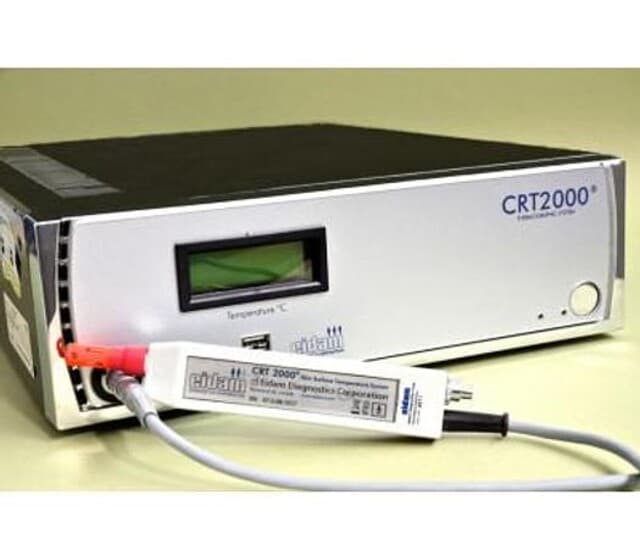
Medical thermography measures the temperature of the skin's surface. At Natural Medical Solutions Wellness Center in Roswell, GA, thermography is performed with the CRT 2000® Thermographic System by Eidam Diagnostics, a Contact Regulation Thermometry instrument. This article explains how that approach works, how it differs from camera-based infrared imaging, and what thermography is not.
Two Different Kinds of Thermography
The word thermography is used for more than one technology. Camera-based infrared thermography, sometimes called digital infrared thermal imaging (DITI), uses an infrared camera to capture heat given off by the skin from a distance and displays it as a color image.
Contact Regulation Thermometry, the approach used by the CRT 2000®, works differently. A temperature sensor is touched to the skin at a standardized series of measurement points. The measurements are taken twice, before and after a waiting period in cooler room air, and the instrument records the readings from both rounds.
Thermography at our clinic is performed with the CRT 2000®, so descriptions of infrared cameras and color heat images that you may read elsewhere do not describe the procedure you will have with us.
How the CRT 2000® Works
The CRT 2000® is a Contact Regulation Thermometry instrument made by Eidam Diagnostics. Its sensor measures skin-surface temperature by contact at defined points across the body, and the readings are presented as a thermogram organized by body region, such as the head, neck, chest, upper and lower abdomen and back.
- The sensor measures temperature by touching the skin. No X-rays or other radiation are used.
- Nothing is injected, and there are no dyes, needles or compression.
- Measurements are taken at a standardized set of points on the body.
What to Expect at a Thermography Appointment
When you schedule, our office will explain how to prepare, what to wear and how long the appointment takes. During the appointment a technician touches the sensor to a series of measurement points on the skin, and the measurements are repeated after the waiting period. Nothing is injected and no radiation is used.
Your provider reviews the readings together with your health history and other information. The readings are not a diagnosis.
The Benefits and Limits of Thermography
The benefits people often mention are about the procedure itself:
- It uses no radiation.
- Nothing is injected, and there are no dyes, needles or compression.
- The sensor only touches the surface of the skin.
Its limits matter just as much:
- It does not diagnose disease.
- It is not a substitute for mammography or any other recommended screening.
- It is not a replacement for seeing a physician about new or worsening symptoms.
Thermography and Breast Screening
Thermography should never be used in place of mammography. Any provider offering it as a mammogram replacement is telling you something the FDA disagrees with.
If you have a family history of breast cancer or another reason for higher risk, talk with your physician about which screening tests are recommended for you and when. Thermography does not replace any of them.
Frequently Asked Questions
Is thermography safe?
The CRT 2000® measures temperature by touching a sensor to the skin. It uses no X-rays or other radiation, and nothing is injected. That describes the procedure only; it does not mean thermography can find what a mammogram finds.
How is this different from infrared camera thermography?
Infrared camera thermography captures heat from the skin from a distance as a color image. The CRT 2000® uses a sensor that touches the skin at standardized points, and takes the measurements twice, before and after a waiting period.
Does a thermography appointment involve needles?
No. The sensor is touched to the skin at each measurement point. There are no needles, injections, dyes or compression.
Is thermography covered by insurance?
Coverage varies by plan, so check with your insurance provider before scheduling.
Sources
- U.S. Food and Drug Administration: Thermogram Is No Substitute for Mammogram.
- National Cancer Institute: Breast Cancer Screening.
This article is educational and does not replace personalized medical advice.
Ready to heal naturally?
Start your personalized naturopathic, functional & holistic care plan in Roswell, GA, proudly serving Alpharetta, Atlanta & the greater Fulton County area.
Search
Categories
- Adrenal Health 1
- Benefits of Detoxification 2
- Brain Health 2
- Breast Cancer 1
- Cardiovascular Disease 1
- Colonic Hydrotherapy 5
- Conditions 10
- Corrective Massage Therapy 1
- Diarrhea 1
- Gut Health 6
- Heavy Metal Detox 1
- Hormonal Imbalance 1
- Hyperbaric Oxygen Therapy 2
- Immune Health 1
- Lifestyle 8
- Nutrition and Health 12
- Treatments 12
- Health and Wellness 12
- Weight Management 2
- Whole Body Health 11
- Soft-Shell Hyperbaric Chamber 1
Recent Posts
- Adrenal Fatigue: Symptoms and Solutions April 2026
- Benefits of Colon Hydrotherapy April 2026
- Benefits of Hyperbaric Chamber Oxygen Therapy April 2026
- Beyond the Bulb Syringe: Why Colon Hydrotherapy Offers a More Thorough Cleanse April 2026
- Brain’s Role in Mental Health April 2026
- Colon Hydrotherapy in the Atlanta Metro Area April 2026
Tags